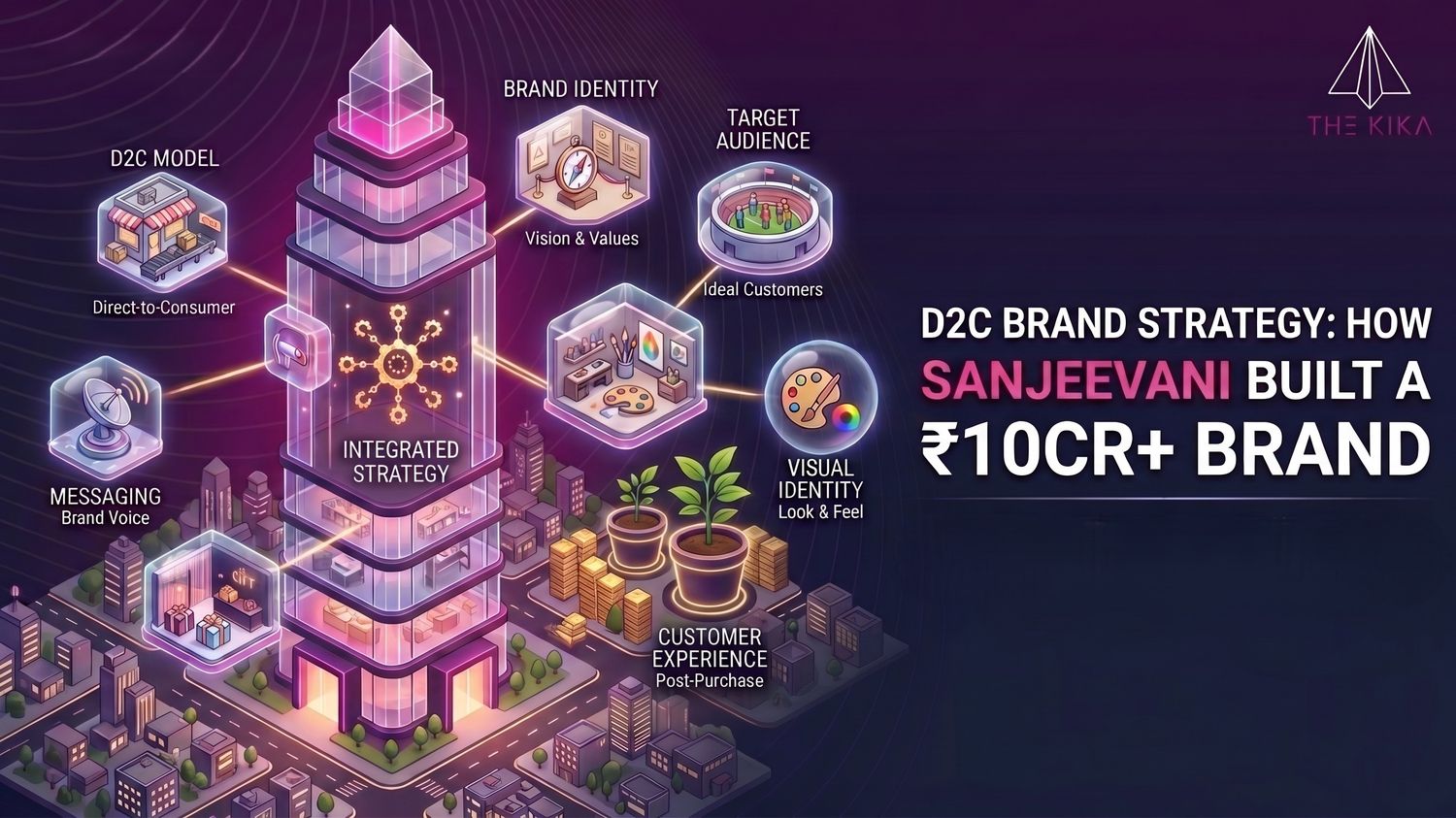
How Sanjeevani Cold Pressed Oils Grew to ₹10 Crore+ in Less Than 2 Years (Case Study)
Sanjeevani Cold Pressed Oils is a D2C (Direct-to-Consumer) brand that grew from zero to ₹10 crore+ in annual revenue in less than 2 years.
How did they do it in a crowded market with 50+ competitors?
Strong brand strategy.
In this case study, I’ll reveal the exact strategy THE KIKA used to position, brand, and market Sanjeevani from launch to ₹10Cr+. This isn’t theory. This is real, proven strategy you can apply to your D2C brand.
THE SANJEEVANI CHALLENGE
When Sanjeevani came to THE KIKA, they had:
- A great product (premium cold-pressed oils)
- Small initial funding (₹15 lakhs)
- Big competition (50+ brands already in market)
- No brand identity
- No clear positioning
Their problem: How to differentiate in a crowded market where customers see all cold-pressed oils as the same?
THE POSITIONING INSIGHT
Most cold-pressed oil brands position themselves as “premium” or “healthy.”
Everyone says that. So no one believes it.
We asked a simple question:
What’s the real barrier to cold-pressed oil adoption?
PRICE.
Customers think: “Cold-pressed oil costs 2-3x more than regular oil. It’s expensive. I can’t afford it daily.”
That’s the objection we needed to overcome.
THE STRATEGY: Cost Reframing
Instead of fighting the price argument, we reframed it:
“Not ₹600 for a bottle. ₹10-22 per spoon per day. A daily health investment.”
This simple reframing changed everything.
Instead of:
“Buy an expensive oil bottle”
Now it’s:
“Spend ₹10-22 daily on your health”
₹10-22 per day feels accessible. ₹600 for a bottle feels expensive.
Same product. Different positioning. Completely different psychology.
THE BRAND IDENTITY
Once we had the positioning, we built the brand:
BRAND NAME
Sanjeevani (Sanskrit for “life-giving”)
TAGLINE
“Ancient Wisdom, Modern Wellness”
COLOR PALETTE
Warm golds, creams, deep greens (health, nature, warmth)
PACKAGING
Glass bottles (premium), warm colors, minimalist design, clear health messaging
MESSAGING
- Core message: “Health investment, not indulgence”
- Secondary messages: “Traditional farming,” “Cold-pressed quality,” “Chemical-free”
VISUAL IDENTITY
- Premium but accessible (not ultra-luxury)
- Natural and organic feel
- Warm, inviting colors
- Clean, modern design
THE MARKETING STRATEGY
PHASE 1: FOUNDING (Months 1-3)
LAUNCH STRATEGY
- Pre-launch buzz on Instagram (behind-the-scenes content)
- Email list building (target health-conscious consumers)
- Influencer partnerships (micro-influencers, health coaches)
- Launch sale (first 100 bottles at 30% discount)
GOAL: Get 500 initial customers and social proof
RESULT: 600+ customers in first month. ₹9 lakhs revenue.
PHASE 2: GROWTH (Months 4-8)
CONTENT MARKETING
- Blog posts on health benefits of cold-pressed oils
- YouTube videos on “how to use cold-pressed oil”
- Instagram reels on daily health tips
- Email nurture sequence for repeat customers
PAID ADVERTISING
- Instagram/Facebook ads targeting health-conscious women aged 25-45
- Google Shopping ads for keywords like “buy cold-pressed oil online”
- YouTube pre-roll on health and wellness videos
AFFILIATE PROGRAM
- Partner with health and wellness bloggers
- Commission-based sales model (15% commission)
- Gave affiliates free product for content creation
PARTNERSHIP STRATEGY
- Health store partnerships
- Wellness center collaborations
- Corporate wellness programs
GOAL: Scale to ₹25+ lakhs monthly revenue
RESULT: ₹30 lakhs monthly revenue by month 8.
PHASE 3: SCALING (Months 9-24)
RETENTION FOCUS
- Subscription program (auto-delivery monthly)
- Loyalty rewards program (points for repeat purchases)
- Email re-engagement campaigns
- Customer testimonials and case studies
PRODUCT LINE EXPANSION
- Added sesame oil (month 10)
- Added coconut oil (month 12)
- Added ghee (month 18)
BRAND AUTHORITY
- CEO interviewed on health podcasts
- Featured in wellness publications
- Thought leadership content
- Expert positioning in health and wellness space
DISTRIBUTION EXPANSION
- Launched on major e-commerce platforms (Amazon, Flipkart)
- Expanded partnerships with health stores
- Wholesale to corporate offices
GOAL: Reach ₹10 crore+ annual revenue
RESULT: ₹100+ lakhs/month by month 24 (₹12 crore+ annual run rate).
THE NUMBERS BREAKDOWN
CUSTOMER ACQUISITION
- Average CAC (Customer Acquisition Cost): ₹500-800
- Average Customer LTV (Lifetime Value): ₹5,000-8,000
- LTV:CAC Ratio: 6:1 to 10:1 (excellent)
REVENUE SOURCES
- 60% from repeat customers (subscription + organic orders)
- 25% from new customer acquisition (ads + content)
- 15% from wholesale and partnerships
PROFITABILITY
- Gross Margin: 60-70% (typical for FMCG)
- Net Margin: 20-25% (after all costs)
THE KEY SUCCESS FACTORS
1. POSITIONING
The cost reframing was everything. Without it, Sanjeevani would be another expensive oil brand. With it, they became a daily health investment brand.
2. QUALITY PRODUCT
Positioning gets customers to try. Quality product keeps them coming back. Sanjeevani’s cold-pressed process is genuine. Product quality is non-negotiable.
3. RETENTION FOCUS
Most D2C brands focus on acquisition. Sanjeevani focused on keeping customers. A 50% repeat rate is phenomenal. That’s sustainable growth.
4. CONTENT MARKETING
Instead of just ads, Sanjeevani published helpful content. Blog posts, videos, guides. This built authority and organic traffic.
5. COMMUNITY BUILDING
Sanjeevani built a community of health-conscious customers who became brand advocates. They shared testimonials, referred friends, and stayed loyal.
6. EMAIL STRATEGY
Email was the most profitable channel. With 30,000+ subscribers by month 24, email revenue alone was ₹30+ lakhs/month.
THE CHALLENGES AND HOW WE SOLVED THEM
CHALLENGE 1: High customer acquisition cost initially
SOLUTION: Shifted focus to retention and organic growth. Subscription program reduced need for constant new customer acquisition.
CHALLENGE 2: Margin pressure from competitor price cuts
SOLUTION: Never competed on price. Stayed positioned as premium quality. Customers valued quality over price.
CHALLENGE 3: Supply chain issues (scaling production)
SOLUTION: Partnered with reliable cold-press manufacturers. Built redundancy into supply chain.
CHALLENGE 4: Market saturation (too many oil brands)
SOLUTION: Owned a specific niche (“daily health investment”). Didn’t compete directly with other oils.
LESSONS FOR YOUR D2C BRAND
1. POSITION FIRST, LAUNCH SECOND
Before you launch, know exactly what problem you’re solving and why you’re different.
2. FOCUS ON RETENTION
Acquiring a customer costs 5x more than keeping a customer. Build retention into your model from day one.
3. BUILD EMAIL LIST EARLY
Your email list is your most valuable asset. Start building it before you launch.
4. PUBLISH CONTENT
Content builds authority, brings organic traffic, and positions you as an expert.
5. NEVER COMPETE ON PRICE
Compete on quality, positioning, and brand. Price competition destroys margins.
6. BUILD A COMMUNITY
Your customers should feel like they’re part of a movement, not just buying a product.
THE SANJEEVANI GROWTH TRAJECTORY
| Timeline | Revenue |
|---|---|
| Month 1 | ₹9 lakhs |
| Month 3 | ₹15 lakhs |
| Month 6 | ₹25 lakhs |
| Month 12 | ₹50+ lakhs |
| Month 18 | ₹75+ lakhs |
| Month 24 | ₹100+ lakhs (₹12 crore+ annual) |
From zero to ₹10 crore+ in 24 months.
KEY TAKEAWAY
Sanjeevani succeeded because of strong positioning (“daily health investment”), quality product, retention focus, and content marketing.
If you’re launching a D2C brand, use this framework:
Position first → Build brand → Focus on retention → Scale through content and partnerships → Expand product line.
FREQUENTLY ASKED QUESTIONS
₹10-20 lakhs minimum for product development, branding, and initial marketing. Sanjeevani started with ₹15 lakhs and grew to ₹10 crore+.
Product gets you first customers. Marketing scales you. Both are essential. Great product + weak marketing = slow growth. Weak product + great marketing = quick failure.
What problem am I solving that competitors aren’t? For Sanjeevani, it was cost reframing (daily investment vs. expensive bottle). What’s yours?
Start with your own website (keep margins). Then add marketplaces (expand reach). By month 6-12, you should be on multiple channels.
12-18 months typically. Sanjeevani hit positive unit economics by month 6 and profitability by month 12
CAC should be 1/3 to 1/5 of Customer LTV. If LTV is ₹5,000, CAC should be ₹500-1,500
Friends and family (40%), content and organic (30%), paid ads (20%), partnerships (10%). Don’t rely on ads alone.
Start with a waitlist. Get 500+ people on waitlist before launching. This de-risks your launch