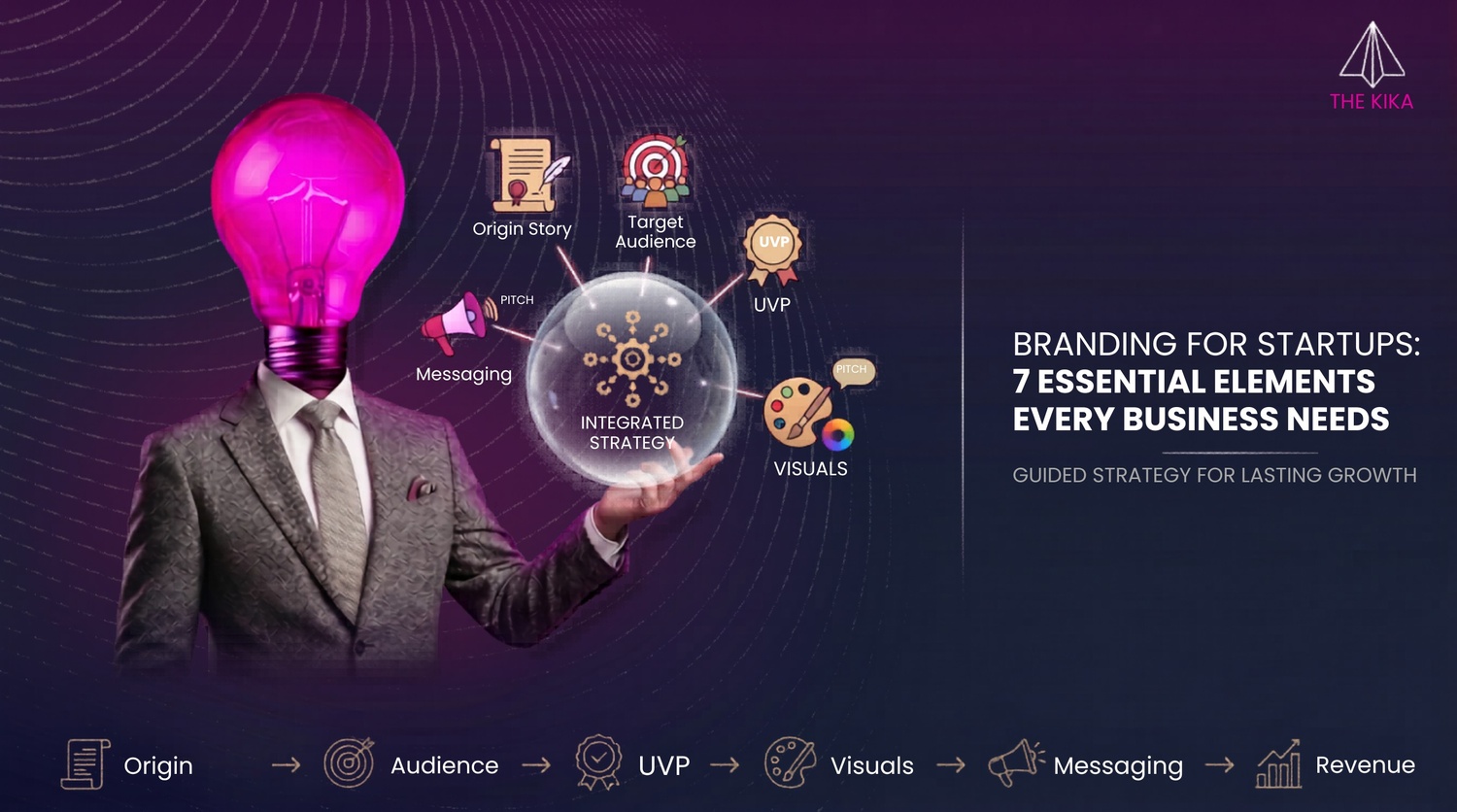
7 Essential Elements of Branding Every Startup Needs
You’re building a startup. You’ve got a great idea, a prototype, maybe some early customers. But one thing’s missing: a strong brand.
Many founders skip branding because they think it’s premature. They think: “Once we have revenue, we’ll invest in branding.”
Here’s the truth: Your brand is what drives revenue. The strongest brands in the world were built from day one, not after they became successful.
In this guide, I’ll break down the 7 essential elements of branding for startups. These are the non-negotiables. Without these 7 elements, your brand will feel incomplete and your messaging will be confusing.
ELEMENT 1: YOUR ORIGIN STORY
Your origin story is the “why” behind your business. Why did you start this? What problem were you solving?
People don’t connect with businesses. They connect with people and their stories.
A great origin story:
- Is authentic (not made up)
- Solves a real problem
- Connects emotionally
- Is memorable and shareable
Example: Sanjeevani’s origin story is about founders who became health-conscious and wanted premium cold-pressed oils. Instead of buying imports, they started their own brand. That story is relatable and authentic.
Your origin story becomes the foundation of your brand narrative.
ELEMENT 2: YOUR TARGET AUDIENCE
You can’t be everything to everyone. You need to know exactly who you’re serving.
Define your target audience by:
- Demographics (age, income, location, education)
- Psychographics (values, beliefs, lifestyle)
- Problems they face
- How they make buying decisions
- Where they spend time online
- What they read, watch, listen to
The more specific, the better. “Health-conscious women aged 25-45 in tier-1 Indian cities who prioritize wellness and are willing to pay premium” is better than “women who care about health.”
ELEMENT 3: YOUR UNIQUE VALUE PROPOSITION
Your unique value proposition (UVP) is what makes you different.
It should answer: Why should customers choose you instead of your competitors?
A strong UVP is:
- Specific (not vague or generic)
- Believable (backed by proof)
- Meaningful (solves a real problem)
- Defensible (competitors can’t easily copy)
Example: “Build a brand that stands out, converts, and scales in 60 days” is more specific than “We do branding.”
ELEMENT 4: YOUR POSITIONING STATEMENT
Your positioning statement is a one-sentence description of your brand.
Format: “For [target audience] who [need/want], [your brand] is [category] that [unique benefit], because [reason to believe].”
Example: “For health-conscious Indian consumers who want premium oils without the imported price tag, Sanjeevani is a cold-pressed oil brand that offers quality + affordability, because we source locally and skip distributor markups.”
This positioning statement should guide every decision you make.
ELEMENT 5: YOUR BRAND PERSONALITY
How would you describe your brand if it were a person?
Is it playful or serious? Modern or traditional? Luxury or accessible? Authoritative or friendly?
Your brand personality shows up in:
- Your language and tone
- Your visual choices (colors, fonts, images)
- How you interact with customers
- What your marketing looks like
THE KIKA’s brand personality is: Professional, strategic, results-driven, accessible to startups, creative, and growth-focused.
ELEMENT 6: YOUR VISUAL IDENTITY
Your visual identity is how your brand looks.
It includes:
- Logo (the visual mark)
- Color palette (2-4 primary colors)
- Typography (fonts)
- Imagery style (photography, illustrations, etc.)
- Layout and spacing
These visual elements should be consistent across all touchpoints: website, business cards, social media, packaging, etc.
ELEMENT 7: YOUR MESSAGING FRAMEWORK
Your messaging framework is how you talk about your brand.
It includes:
- Your tagline/slogan
- Your key messages (3-5 main points)
- Your elevator pitch (30-second explanation)
- Your FAQs and responses to common objections
Your messaging should be consistent but adaptable. You might communicate differently on LinkedIn vs. Instagram, but your core message stays the same.
THE 7-ELEMENT FRAMEWORK IN ACTION
When THE KIKA built Sanjeevani’s brand, we didn’t just design a logo. We developed all 7 elements:
- ORIGIN STORY: Founders’ personal health journey + desire to make premium oils accessible
- TARGET AUDIENCE: Health-conscious, affluent consumers aged 25-45 in metro cities
- UVP: “Premium quality, accessible price, rooted in tradition”
- POSITIONING: “Daily health investment brand for affluent Indians”
- PERSONALITY: Premium yet approachable, traditional yet modern, health-focused
- VISUAL IDENTITY: Warm colors (golds, creams), clean modern design, traditional elements
- MESSAGING: “From ancient wisdom to modern wellness” | “One spoon a day keeps the doctor away”
Result: Cohesive, memorable brand that resonates with target audience.
WHY STARTUPS SKIP THESE ELEMENTS
Most startups skip branding development because:
- They think it costs too much
- They think it’s premature
- They don’t know where to start
- They’re focused on product, not brand
Here’s what usually happens: They skip branding, launch their product, get traction, and then realize they don’t know how to position themselves. They end up rebranding later, wasting money.
THE COST OF SKIPPING BRANDING
No branding = Lower conversion rates, weaker pricing power, harder fundraising, slower customer acquisition, weaker market position.
Proper branding = 3x better conversion rates, 50% premium pricing power, easier funding conversations, faster customer acquisition, dominant market position.
The ROI on branding is 3:1 or better.
KEY TAKEAWAY
Don’t skip branding. These 7 elements are the foundation of your business. They don’t need to be perfect from day one, but they should exist. Start with a basic version and refine as you grow.
FREQUENTLY ASKED QUESTIONS
Research, interviews, and data. Talk to your early customers. Ask: who has the biggest problem you solve? Who benefits most from your product? Build detailed customer personas
Ask: What do I do that competitors don’t? What do my best customers say they value? What problem am I solving better than others?
If bootstrapped: 2-4 weeks (DIY research + strategy). If hiring agency: 6-8 weeks (agency handles everything)
Ideally, both. But if you’re choosing one: Start with product, validate it, then invest in branding. Never skip branding entirely.
You can pivot, but it’s disruptive. Get the targeting right from the start
Create a brand guidelines document. Include story, positioning, personality, visual guidelines, and messaging rules
Track metrics: brand awareness, customer acquisition cost, conversion rate, customer satisfaction, referral rate.
Listen to feedback. If your positioning is wrong, adjust. If your visuals are off, redesign. Your brand should evolve based on market feedback